DOOH Emerges as a Full-Funnel Media Channel in Korea, New Consumer Study Shows

Digital Out-of-Home (DOOH) advertising is rapidly shedding its image as a simple awareness medium and is increasingly being recognised as a performance-driven, omnichannel connector, according to a new consumer perception and effectiveness study released by CJ Mezzomedia. The research highlights how DOOH is reshaping Korea’s outdoor advertising landscape by combining scale, creativity and measurable impact in ways traditional out-of-home formats could not achieve.
The study, conducted via an online survey of 300 consumers aged 15 to 59 who have prior exposure to DOOH, shows that exposure frequency is already high. Sixty-one percent of respondents said they encounter DOOH at least once a week, while 17 percent reported seeing it daily. The most common touchpoints were large digital screens on high-rise building façades, followed by subway stations, trains, shopping malls and buses, underscoring DOOH’s strong presence along everyday urban movement paths .
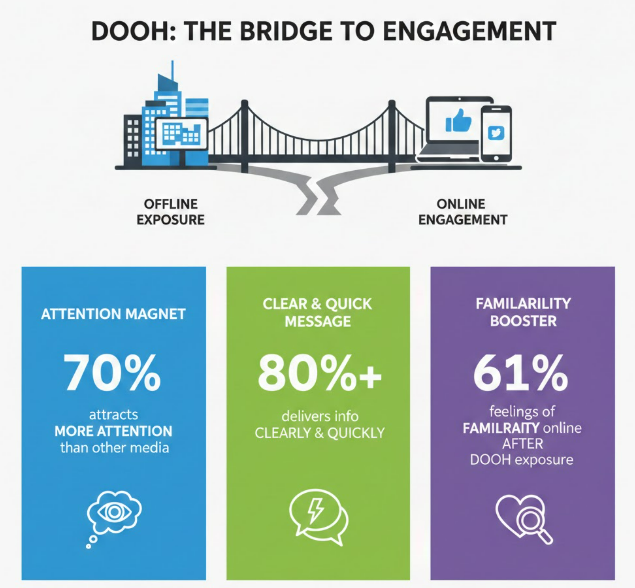
Attention and message delivery emerged as two of DOOH’s strongest attributes. Nearly seven in ten respondents said DOOH attracts more attention than other advertising media, and more than 80 percent agreed that it delivers information clearly and quickly. Importantly, 61 percent said that when they later encounter the same brand or product online, it feels more familiar if they had first seen it through DOOH. This finding reinforces the view of DOOH as a bridge between offline exposure and online engagement, rather than a standalone channel.
Creative preference data also points to a clear direction for advertisers. Brand-image-driven video content ranked as the most favoured DOOH format, ahead of product-centric or promotion-heavy executions. Consumers responded positively to visually distinctive storytelling, while also expressing interest in functional enhancements. Sixty-two percent said they would like future DOOH campaigns to incorporate real-time elements such as weather, time of day or situational context, as well as tangible benefits like coupons or discounts. Interactive features such as QR codes and mobile connectivity also showed meaningful participation intent, with 43 percent indicating they would engage if such options were available .
Crucially, the research suggests that DOOH is influencing behaviour well beyond awareness. Seventy-seven percent of respondents said they had taken some form of action after seeing a DOOH advertisement, including searching for brand or product information, visiting a website or app, or going to a physical store. Nearly half agreed that DOOH has a positive impact on brand recognition and purchase decisions, a figure that positions the medium closer to the consideration and conversion stages of the funnel than is often assumed.
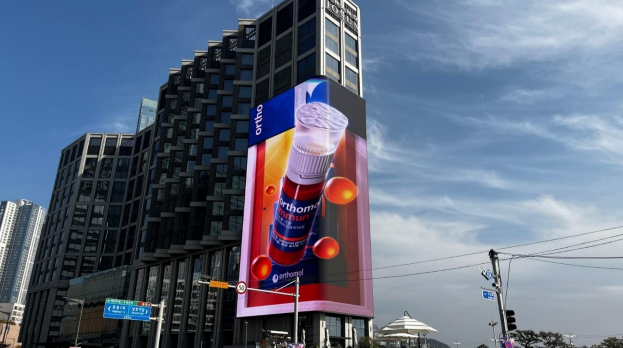
A featured case study illustrates this shift in practice. CJ Mezzomedia partnered with Dong-A Pharmaceutical to promote its health supplement brand Orthomol using a large-scale 3D anamorphic DOOH installation at the Grand Josun Busan site. The campaign was extended through location-based mobile messaging via TMAP and followed by online retargeting using collected advertising IDs. The integrated approach demonstrated how DOOH can act as the trigger for an O2O (offline-to-online) marketing flow, linking spectacle with measurable digital outcomes .
Taken together, the findings suggest that DOOH in Korea is entering a more mature phase. As regulatory environments loosen through designated free-display zones and as data integration improves, DOOH is increasingly positioned not just as a visual medium, but as a strategic hub within omnichannel media planning. For advertisers seeking both impact and accountability, DOOH is becoming harder to ignore.
한국 최초 글로벌 옥외광고 뉴스레터
세계 옥외광고 뉴스를 편하게 이메일로 받아 보는 법!



![[신간도서] NEXT OOH](https://cdn.media.bluedot.so/bluedot.oohnews/2025/06/wr0mf3_202506030151.JPG)