Seoul Ranks Seventh Among Global Business Travel Destinations in 2025

According to data released by ForwardKeys in its report “Wrapping Up: Top Ranking Destinations in 2025”, Seoul ranked seventh worldwide among destinations generating the highest level of interest from business travellers flying internationally in 2025. The result places the South Korean capital firmly within the top tier of global corporate travel hubs, despite intensifying competition among major cities.
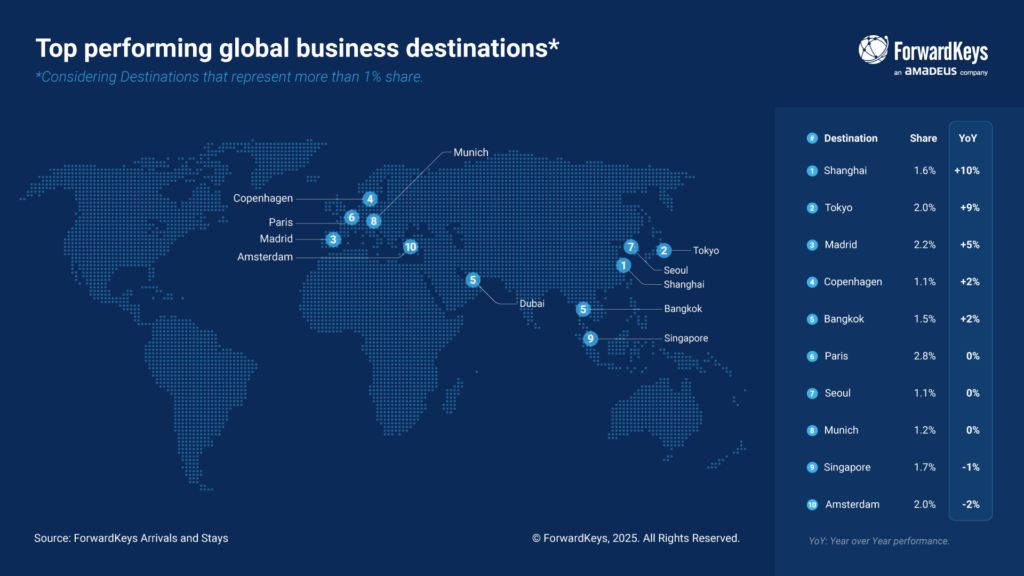
The 2025 rankings confirm that established global centres continue to dominate business travel flows. London maintained its position as the world’s most popular destination overall, supported by its role as a financial and commercial crossroads. Tokyo strengthened its standing with robust year-on-year growth, while Shanghai emerged as the fastest-growing international business destination, recording double-digit growth compared with 2024.
Against this backdrop, Seoul’s seventh-place ranking stands out for its stability rather than rapid expansion. While the city did not post the strongest growth rates among its peers, it maintained a consistent share of global business travel demand. This reflects Seoul’s structural strengths, including its advanced digital infrastructure, strong manufacturing and technology sectors, and its role as a regional base for multinational corporations operating across Northeast Asia.
The broader regional picture in 2025 shows a clear rebound in North Asia. Mainland Chinese cities such as Beijing, Shanghai and Guangzhou recorded strong year-on-year increases, underlining the return of international corporate mobility into the region. This momentum has indirectly supported Seoul, which benefits from close economic ties with both China and Japan, as well as its position as a practical and neutral meeting point for regional headquarters and cross-border business activity.
Seoul’s convention and exhibition ecosystem has also contributed to its performance. International events across technology, semiconductors, batteries, biotechnology and entertainment continued to attract overseas delegates. Major venues, including the COEX complex and the wider Gangnam business district, reinforced the city’s capacity to host large-scale corporate gatherings, while Incheon International Airport provided the connectivity required to sustain long-haul and regional business travel.
The 2025 data also highlights a contrast between leisure-led and business-led travel trends. Destinations such as Madrid and Alicante drew attention for double-digit growth driven largely by leisure demand. Business travel, by comparison, remained more selective and structurally anchored. Corporations prioritised destinations offering reliable infrastructure, strong commercial ecosystems and long-term relevance, factors that continue to underpin Seoul’s position.
Looking ahead, Seoul faces growing competition from Asian and Middle Eastern cities investing aggressively in airports, convention facilities and global branding aimed at corporate travellers. Maintaining its position will depend on continued investment in connectivity, business-friendly policies and the quality of the urban experience offered to international visitors.
Still, ranking seventh globally in 2025 confirms Seoul’s status as a key node in international business travel, reflecting resilience, relevance and a sustained role within the global corporate network.
한국 최초 글로벌 옥외광고 뉴스레터
세계 옥외광고 뉴스를 편하게 이메일로 받아 보는 법!


![[신간도서] NEXT OOH](https://cdn.media.bluedot.so/bluedot.oohnews/2025/06/wr0mf3_202506030151.JPG)