Airports Face Defining Year as Global Traffic Surges in 2026

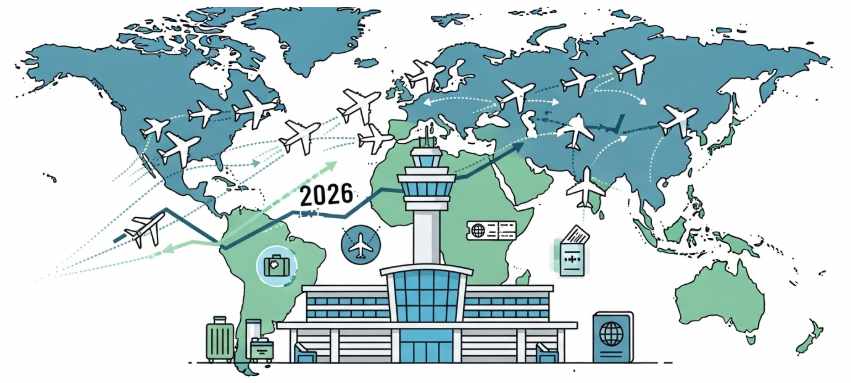
Global airports are entering a pivotal phase as passenger volumes approach historic highs, placing renewed pressure on infrastructure, sustainability, and long-term investment planning. According to Airports Council International World, global passenger traffic is projected to reach 10.2 billion in 2026, with demand expected to nearly double to 18.8 billion passengers by the mid-2040s .

Justin Erbacci, Director General of Airports Council International World, says this growth presents both opportunity and risk. While emerging and developing markets continue to drive structurally strong demand, regional disparities are widening. Infrastructure bottlenecks, aircraft delivery delays, operational constraints, and mounting sustainability expectations threaten to limit expansion if not addressed through coordinated industry action.

Against this backdrop, ACI World has outlined five strategic priorities for 2026.
First, the organization will intensify global advocacy efforts through its Policy Agenda 2030. Engagement with governments, the International Civil Aviation Organization, and key industry stakeholders will focus on reinforcing airports’ role as competitive commercial enterprises and vital economic engines. Participation in the Seventh Worldwide Air Transport Conference (ATConf/7) will be central to shaping global air transport economic policy, particularly around infrastructure financing and long-term investment frameworks. Modernizing airport slot policy is also high on the agenda as capacity pressures intensify worldwide.
Second, environmental stewardship remains a defining issue. ACI World plans to publish a milestone assessment of airport progress toward net-zero carbon emissions by 2050. The sector will continue advancing climate adaptation strategies, promoting Sustainable Aviation Fuels, and strengthening initiatives such as the Airport Carbon Accreditation program. Sustainability is no longer peripheral; it is increasingly embedded in airport competitiveness and access to capital.
Third, data and intelligence will underpin more informed decision-making. ACI World intends to expand its forecasting and economic publications, including updated traffic reports and industry outlooks. Two new global research projects—covering airport capital expenditure needs through 2055 and comparative development models—aim to provide clearer guidance for governments and investors facing significant infrastructure funding gaps. Practical implementation tools, including guidance on One-Stop Security systems, are expected to support operational efficiency and seamless passenger journeys.
Fourth, the organization will enhance its service programs, marking the 20th anniversary of the Airport Service Quality initiative with a refreshed framework emphasizing stronger quality control and value delivery. Expanded training programs and the launch of a Young Professionals initiative reflect growing recognition that leadership development is critical as airports navigate digital transformation and sustainability challenges.
Finally, governance and leadership renewal will shape the year ahead. The ACI World Governing Board has appointed Jost Lammers, Chief Executive Officer of Munich Airport, as Chair for the 2026–2027 term. His appointment signals a focus on innovation, resilience, and strategic consensus-building at a time when airports must balance rapid growth with structural reform.
The message from ACI World is clear. Traffic growth alone will not guarantee long-term prosperity. Airports that succeed in 2026 will be those that secure policy support, accelerate sustainability, invest wisely, and strengthen operational excellence in an increasingly complex global aviation ecosystem.
한국 최초 글로벌 옥외광고 뉴스레터
세계 옥외광고 뉴스를 편하게 이메일로 받아 보는 법!



![[신간도서] NEXT OOH](https://cdn.media.bluedot.so/bluedot.oohnews/2025/06/wr0mf3_202506030151.JPG)